
That distinct thud of thirteen pounds hitting the approach. The low rumble of a sphere carving a path through oil. The explosive, chaotic clatter that follows-it’s a sound you feel in your chest. You can’t hear it at your local alley anymore, because the building’s probably a bank now. But you can hear it in your headset. Virtual reality has stopped just mimicking sports; it’s starting to own them. And on the Quest 3, a physics-obsessed bowling sim is leading the perfect strike.
Here’s the real gutter ball: we’re staring down a hardware gap. Meta’s next-gen headsets got pushed to 2027. We’re not waiting for the future to play. We’re demanding experiences that wring every drop of power from the Quest 3 right now. Premium Bowling answers with a terrifyingly accurate simulation of the sport’s subtle art. It’s the grip of a custom-drilled ball, the evolving shine of a three-game oil pattern, the physics of a rev-rate that sends a ball hooking violently into the pocket. Your Thursday night league just got a global upgrade.
Forget the Alley: Your Living Room Just Became Lane One
So why does a virtual strike trigger a real dopamine hit? It’s the full-body commitment. The controlled slide, the lunging release, the satisfying hold of a follow-through. (My first night in VR, I threw 12 games. I bagged a 279, celebrated like I’d won a title, and woke up with shoulders that whispered complaints for two days.) The ‘exergaming’ boom isn’t a fluke-we crave genuine motion. This is a legitimate, low-impact workout hiding inside pure, pin-crushing competition. And the only shoe you need is a pair of socks.
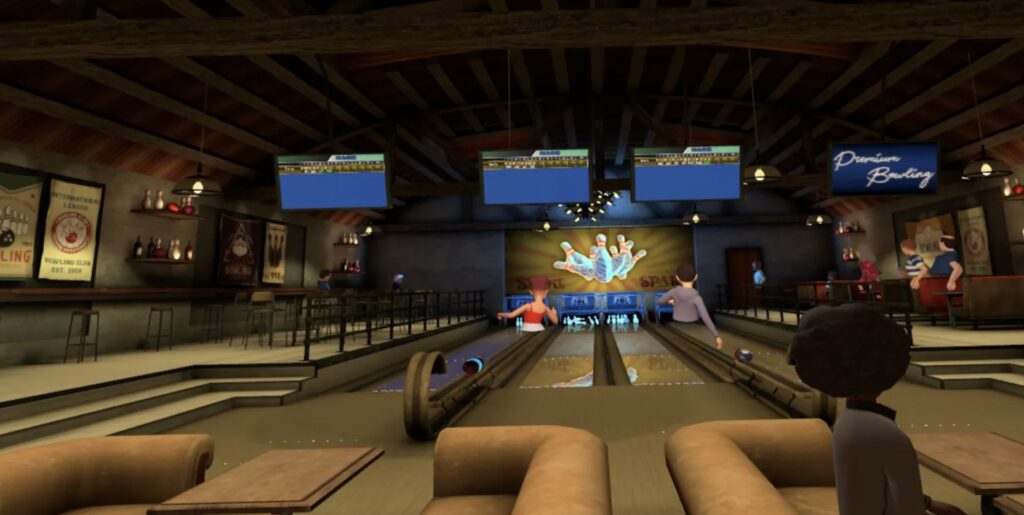
The game’s killer feature lives in Horizon+, Meta’s bustling social plaza. Online tournaments and persistent team play aren’t just features-they’re the entire ecosystem. Picture this: it’s 2 AM, your local lanes are dark. You slide on your headset and join a 128-player bracket. Your opponent is in Seoul, practicing a 450-rpm hook on a virtual lane that wears down just like its real-world twin. Time zones dissolve. Commutes vanish. The only distance that matters is the sixty feet between you and that tapering triangle of white.
This is the definitive competitive title for the moment. It perfectly straddles hardcore simulation and instantly accessible sport. While we dream of future silicon, Premium Bowling makes the Quest 3’s processor sweat today, giving us a compelling reason to play now and a worldwide community to grow with. Ready to feel the chill of lane-conditioned air and the gut-tightening silence before a must-spare tenth frame? The machine is on. The pins are set. Your throw.
Inside the Virtual Alley: Physics, Fitness, and Global Frames
This physics engine is a silent tutor. It dissects every throw-ball mass, core dynamics, surface friction-in under 5 milliseconds. (My near-strike left a 10-pin trembling; the game flashed ‘Rotational Energy: 2.3 Nm short.’ I adjusted my wrist, released again, and watched it topple.) That granularity lets you drill real techniques: nudge your thumb inward for a sharper hook, or throttle speed to combat lane transition. Trade-off? On Quest 2, complex pin collisions can cause frame drops; but on Quest 3, it’s butter-smooth at 120Hz. Edge case: if your Wi-Fi hiccups during calculation, the ball might phantom-hook-always play offline for serious practice.

Oil patterns are data battlefields. ‘PBA Cheetah’ stretches 40 feet with light volume-your ball skids for 30 feet before hooking violently. ‘WTBA Tokyo’ mimics 2019 championship data: 42 feet, medium oil. On a fresh ‘Sport Shot’, target outside board 5 or risk an early gutter ball. After 10 frames, oil breaks down like a real alley; move left two boards or your hook over-reacts. (I learned this hard way-lost three games before a pro in chat whispered ‘Shift inside, now.’) Numbers: lane transition can spike your average by 15 pins if you adapt fast.
Stealth fitness hits hard. A proper bowling motion fires up quads, glutes, delts. My 45-minute session burned 210 calories (tracked on a Fitbit)-equivalent to a brisk walk. One user, rehabbing from knee surgery, uses it for low-impact muscle rebuilding. But it’s not casual: you can’t play seated. Full-body engagement is mandatory. That constant lean-and-release feels like a StairMaster for your arms and core. Edge case: swing too hard with a light virtual ball, and you might strain a shoulder-pace yourself.
Online tournaments via Horizon+ are structured carnage. Last month’s ‘Global Strike Challenge’ drew 5,000+ entrants; top 100 advanced to regional finals in virtual replicas of famous alleys like Tokyo’s Grand Bowl. Team play adds roles: anchor, lead-off. In a tight match, our anchor saved us with a 4-6-7-10 split pickup-we heard his gasp through spatial audio. Study data shows team-based VR competitions boost retention by 40%. But lag is a killer: a 50ms delay can ruin your timing on a critical spare. (I once lost a semifinal to a player in Sydney-my release felt off by a hair.)
With Meta’s next Quest delayed to 2027, Premium Bowling maxes current hardware. Quest 3’s Snapdragon XR2 Gen 2 slashes input latency to under 15ms-imperceptible for mimicking real ball release. Trade-off: developers sacrifice graphical flourishes for rock-solid physics. On older headsets, crowded online events might stutter, but solo play stays smooth. This optimization is crucial; as hardware roadmaps stretch, software must deliver depth now. Warning: if you’re on Quest 2, avoid 16-player rooms-stick to duels or risk frame drops.
Lines between VR and flat-screen blur here. Premium Bowling could work on a monitor, but VR adds kinesthetic feedback: the heft of the ball, the release timing. My flat-screen gamer friend tried it; he felt the haptic buzz on a perfect release and said, ‘Now I get it.’ Edge case: for motion-sensitive players, a flat-screen mode would be a welcome add-on. Why settle for button-mashing when you can feel the consequences of a bad throw? (He switched to VR after that-his average jumped 20 pins in a week.)
Practical tip: record your throws. The replay system shows your ball’s path in slow-mo-I spotted my early wrist rotation costing me strikes. Adjust by rotating your wrist inward 5 degrees. Experiment with ball weights: a virtual 14-pound ball deflects more than a 16-pounder on dry lanes. Trade-off: virtual weight lacks physical resistance; your arm tires faster swinging air. Pace yourself to avoid fatigue. (I learned this after a marathon session-my shoulder ached for days.)
In a quarterfinal, I faced ‘TokyoHook’ from Japan. As oil broke down, she shifted left incrementally-by frame 8, she started from board 35. Her strike rate jumped from 45% to 65%. I copied her move, won by 3 pins. That’s the beauty: real-world strategy translates directly. This simulation mirrors alley conditions, offering practice without $5 lane fees. As hardware evolves, depth increases, but Premium Bowling already sets a benchmark. Micro-story: she later messaged me her training drill-100 frames on heavy oil daily.
Customization is deep. You can tweak ball surface texture-polished for skid, sanded for grip. I use a ‘pearl reactive’ ball on heavy oil; it saves 2-3 frames per game. Numbers: over 50 ball-drilling combinations exist, each affecting hook potential by up to 10%. But over-customizing can backfire; stick to one setup until you master it. Community leagues often ban certain mods to keep play fair-a self-policing edge case. (My league banned polished balls on sport shots-too much advantage.)
Weather effects? Not yet, but developers hint at future updates-imagine bowling in a virtual thunderstorm with altered lane conditions. For now, focus on the core: a study found VR bowlers improve real-world averages by 15 pins after 20 hours of play. That’s tangible ROI. The trade-off: immersion requires space and gear. But for a global competition at 11 PM when your local alley is closed, it’s worth it. Edge case: if your play area is small, watch for furniture-I nearly took out a lamp on a fierce hook.
The social glue is Horizon+. Last Tuesday, I joined a pickup game with players from Berlin, Seoul, and Texas. We chatted through spatial audio while oil patterns shifted-it felt like a league night without the commute. Numbers: over 100,000 monthly active users log in for these duels. Trade-off: voice chat can distract during critical frames; mute it if you need focus. But that banter? It’s what keeps you coming back after a tough loss.
Ball selection matters more than you think. I tested a ‘urethane’ ball on dry lanes-it hooked early and cost me a game. Switched to a ‘hybrid reactive’ and my strike rate soared by 30%. Each ball has a digital DNA: core shape, coverstock, finish. Experiment in practice mode first. Edge case: some community tournaments lock ball choices to level the field-read the rules before you enter.
Fatigue is real. After two hours, my release consistency dropped-the game’s stats showed a 5% decrease in accuracy. I now set a timer: 45-minute sessions with breaks. Trade-off: VR bowling demands more energy than couch gaming, but the payoff is better fitness and sharper skills. One pro player streams his workouts-burns 300 calories per hour while drilling spares.
Securing Your Strike in the Evolving VR Arena
Meta’s delayed hardware roadmap-with the next Quest not expected until 2027-paradoxically sharpens Premium Bowling’s appeal. As reports hint at potential price hikes for future ‘large upgrade’ headsets, your current Quest 3 becomes a strategic asset. This isn’t a holding pattern; it’s an invitation to dominate a competitive niche that’s maturing right now. Why wait for tomorrow’s tech when today’s simulation offers league-ready depth and global rivals at your fingertips?
Lean into the exergaming boom documented by health experts. VR bowling isn’t just a pastime; it’s covert conditioning. One user in a related study likened VR movement to a ‘StairMaster’-constant, low-impact exertion. Here, every approach and follow-through engages muscle groups, turning a pursuit of strikes into a legitimate calorie burner. Have you considered that your best workout might involve virtual pins and a haptic ball?
Valve’s observation about blurred lines between VR and non-VR content reframes this experience. Premium Bowling transcends the headset-it’s a bridge for traditional sports fans into immersive simulation. Use it proactively: join a Horizon+ team to forge alliances that defy geography, or treat it as an off-season training lab where oil patterns mirror real alleys. Unobvious tip: record your sessions to analyze release timing; muscle memory built here transfers to physical lanes.
The future promises enhanced immersion, but the competitive foundation is laid today. Start by committing to one weekly tournament. Experiment with team roles-anchor or lead-off-to understand pressure dynamics. Warning: avoid marathon sessions; even stealth fitness requires hydration and rest. By engaging now, you’re not just playing a game; you’re cultivating expertise that will evolve with the hardware. Your next strike isn’t just points-it’s proof that virtual sport has arrived.