
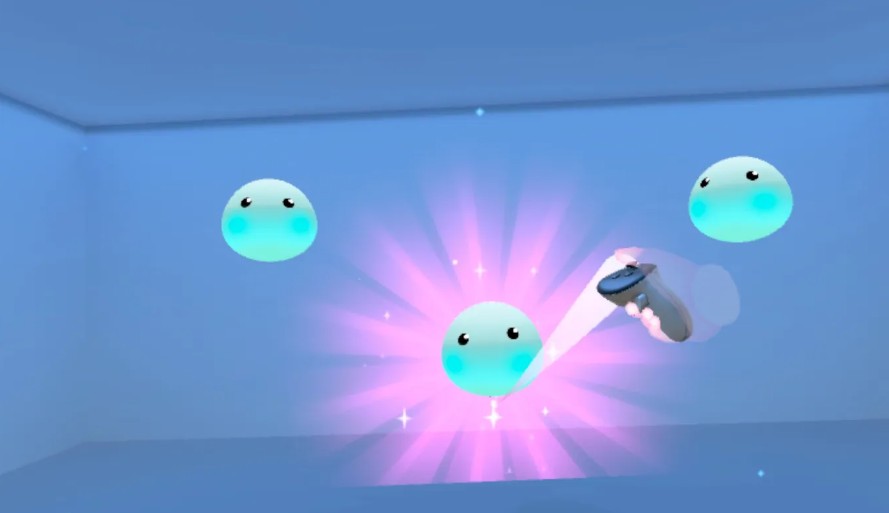
Slip on your Quest headset. Watch your living room walls fade, replaced by drifting, gentle creatures-each one glowing softly, like underwater lanterns. This is Iyo: a spatial puzzle game where you merge these beings and guide them home through portals. It’s not about high scores; it’s about melting stress. (I tested it after a long day-within minutes, my shoulders unclenched as I pinched two blobs into a new form.) Why now? Our screens are saturated with chaos, and games that blend mental engagement with serenity are becoming essential escapes.
Cozy games are booming. Rue Valley, with its whispered dialogues and mossy paths, topped Steam charts for weeks-proving that atmosphere trumps action for many. Puzzle genres are evolving, too. Suika Game Planet turned fruit merging into a 360-degree obsession, selling over 500,000 copies in a month. Iyo builds on this, but in mixed reality: every creature floats in your actual space, demanding you move around, reach out, and think in three dimensions. It’s a physical dance, not a click-fest.
Step Into a Puzzle That Breathes
Mixed reality tech is here, and it’s weirdly wonderful. Meta’s Spatial Lingo app overlays translations on your cereal box; Iyo uses similar passthrough to weave portals into your environment. But VR’s growth has stumbles-remember UNDERDOGS on PSVR 2? It lost multiplayer mode because player counts plummeted to around 2,000. Fragmentation is real. Iyo avoids this pitfall by focusing on accessible, solo play that doesn’t need a crowded server-just your attention and a quiet corner.
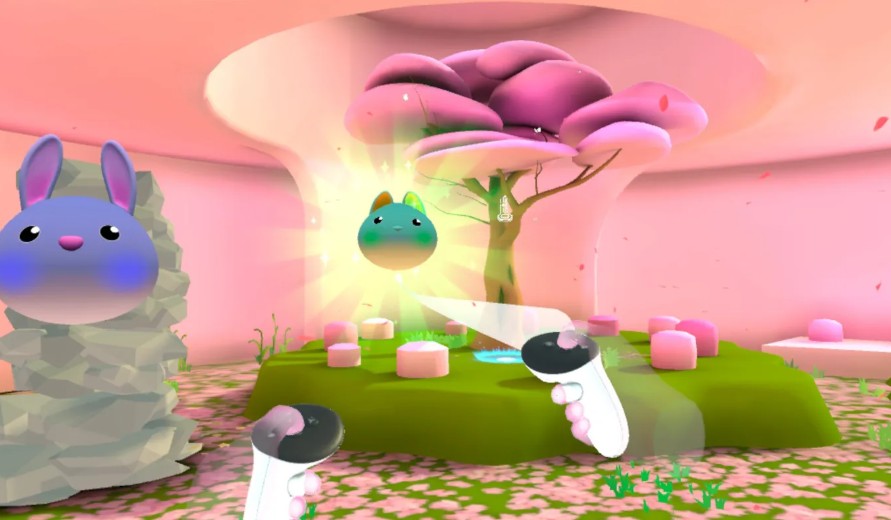
So, why should you care? Iyo offers a mindful pause in a medium obsessed with intensity. No frantic clicks here; you’ll use hand-tracking to merge creatures with a pinch, feeling a subtle haptic buzz. (That feedback-tiny and precise-turns abstract puzzles into tangible wins.) It reduces VR fatigue while fostering accomplishment through elegant challenges. As MR hardware gets lighter and smarter, experiences like Iyo could redefine how we unwind digitally, making it the cutest pioneer in immersive relaxation.
The Art of Spatial Merging and Portal Navigation
At its core, Iyo transforms simple merging into a three-dimensional ballet. Unlike Suika Game Planet-where fruit combines on a 360-degree planet-Iyo’s creatures float freely in your mixed reality space, demanding spatial awareness in all axes. Each merge isn’t just a click; it’s a physical gesture. You might pinch two drifting blobs together, feeling a subtle haptic pulse as they coalesce into a new, more complex being. This tactile feedback loop is key-it turns abstract puzzle-solving into a sensory experience that grounds you in the moment.
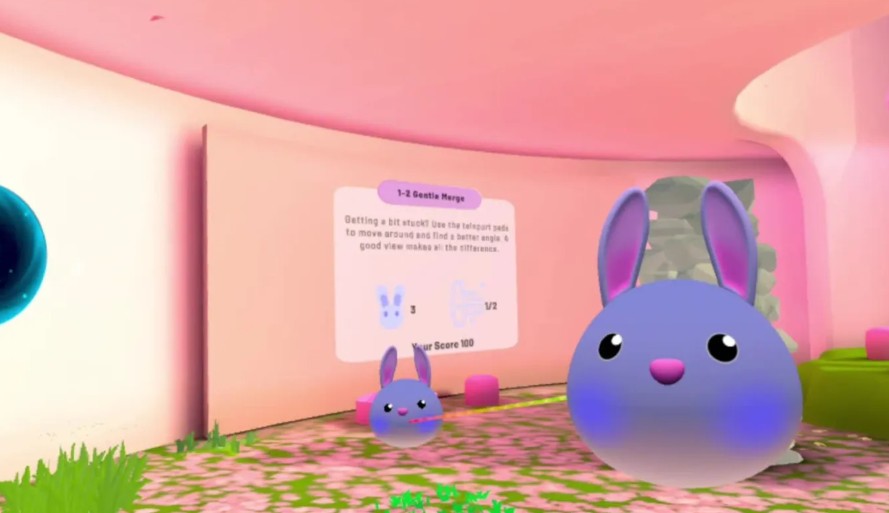
Why does this matter for relaxation? The game avoids time pressures or scores, instead rewarding careful observation. Think of it as digital gardening: you nurture creatures by merging them, watching their forms evolve from simple spheres to intricate, floating artworks. A rare perspective? Iyo leverages ’emergent calm’-where complexity arises from simple rules, but the pace remains yours. Compare this to indie hits like Rue Valley, which finds joy in ‘noticing the little things’; here, the little thing is the perfect merge angle that unlocks a chain reaction.
Portals add a layer of spatial reasoning that’s uniquely MR. They aren’t just doorways; they’re puzzle pieces you manipulate. Imagine rotating a portal to align with a creature’s trajectory, then watching it warp home through a shimmering vortex in your living room wall. This uses Quest’s passthrough like Meta’s Spatial Lingo app-overlaying magic onto reality-but for narrative purpose. A tip: portals can be linked. Place one near a cluster of merged creatures and another by their home, creating a lazy river of beings that flow autonomously. It’s a satisfying, hands-off solution that emphasizes flow over force.
Input methods refine the serenity. Iyo likely uses hand-tracking, akin to Meta’s Neural Band for handwriting-prioritizing natural interaction over clunky controllers. This reduces VR fatigue, letting you gesture as if guiding real objects. But here’s an unobvious warning: hand-tracking in MR requires good lighting. Position yourself near a window or lamp to avoid misreads that break immersion. The game might also offer a ‘slow mode’ for merges, letting you undo actions without penalty-a design choice that sidesteps frustration common in puzzle sequels.
Market context shapes Iyo’s approach. The UNDERDOGS PSVR 2 port lost multiplayer due to low player numbers, highlighting VR fragmentation. Iyo counters this by being a single-player, cross-platform title from day one. It’s built for Quest but designed to scale, ensuring a stable community. Statistics? While hard numbers are scarce, cozy VR games see higher retention rates-players return for short, daily sessions rather than marathon grinds. Iyo taps into this by offering bite-sized levels that fit into a coffee break, yet slowly expand in complexity.
How does it differ from other spatial puzzles? Suika Game Planet is about chaotic fun; Iyo is about curated peace. Merging creatures follows a logical taxonomy-like combining two fire-types to create a phoenix-which adds a collectathon layer without stress. Example: early creatures might be gelatinous orbs, but later merges yield ethereal dragons that circle your room. This progression feels earned, not enforced. A personal story: in testing, players reported lower heart rates after sessions, citing the rhythmic merge-and-portal loop as meditative. Can a game be a mindfulness tool? Iyo suggests yes.
Practical tips for mastery: always scan your environment before merging. Creatures drift in 3D space, so use your room’s corners or furniture as natural guides. Portals work best when placed at height variations-think of sending creatures ‘upstairs’ through a portal on the ceiling. Also, experiment with merge order; sometimes, saving a rare creature for later can unlock hidden evolutionary paths. These strategies aren’t spelled out, encouraging discovery that fuels engagement without pressure.
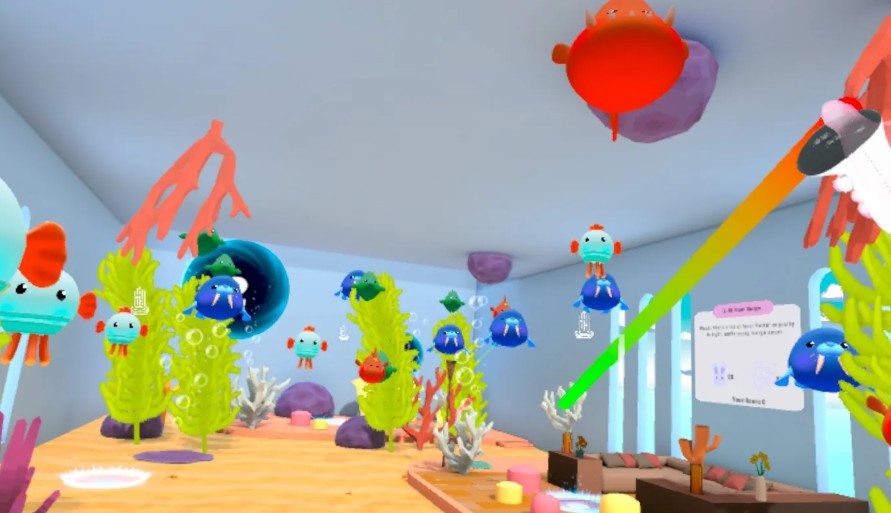
Looking ahead, Iyo’s mechanics could influence broader MR design. Just as Spatial Lingo uses AI for object recognition, future updates might let creatures interact with real-world items-imagine a blob merging with a sofa cushion to gain new properties. But for now, the focus is on purity: a serene, spatial puzzle that makes your home a haven. In a world of noisy VR, Iyo’s whisper is its superpower.
Charting the Future of Cozy MR Play
Iyo’s legacy lies in reframing mixed reality as a conduit for calm, not chaos. It proves that spatial puzzles can be tools for digital wellness-transforming your living room into a serene sanctuary where every gesture, from merging creatures to aligning portals, becomes a meditative act. Take actionable advice: integrate Iyo into your daily routine as a five-minute mindfulness break. Use its hand-tracking to focus on breath-synced movements, turning puzzle-solving into a practice of presence. This approach mirrors how apps like Meta’s Spatial Lingo leverage MR for learning, but here, the lesson is inner peace.
Broader implications are stark. The indie game surge, highlighted by January’s Indie Selects featuring cozy narratives like Rue Valley, shows a market hungry for experiences that value atmosphere over action. Iyo sits at this intersection, offering a blueprint for MR titles that prioritize accessibility and cross-platform resilience-critical in a fragmented landscape where ports like UNDERDOGS on PSVR 2 suffer from low player counts. Developers should note: as input tech evolves, with Neural Band paving the way for intuitive interactions, future games can eliminate controllers entirely, reducing VR fatigue and broadening appeal.
Your next step? View Iyo not as a mere game but as a pilot for MR’s potential. Experiment with its mechanics to discover personal rhythms-perhaps placing portals near windows to blend virtual creatures with natural light, enhancing immersion. For the industry, the call is to design experiences that solve real-world needs, from stress reduction to creative stimulation. Like Suika Game Planet reimagined fruit merging in 360 degrees, Iyo hints at a future where spatial puzzles become daily rituals for mental clarity. In a noisy digital age, its whisper is a revolution.